Unveiling the Mysteries of Black Hole Stars: The Discovery of MoM-BH*-1
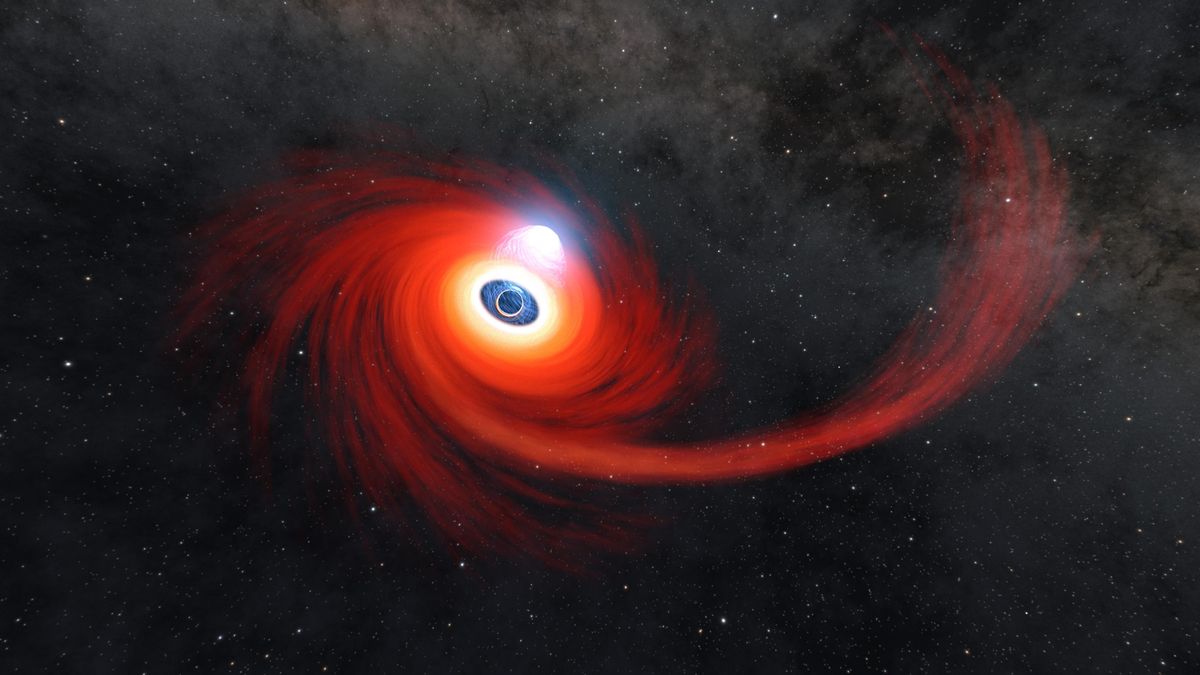
A groundbreaking discovery has been made in the early universe with the identification of the most distant 'black hole star' ever found, existing less than 660 million years after the Big Bang. This discovery sheds light on the mysterious "little red dots" seen in images from the James Webb Space Telescope, believed to be supermassive black holes surrounded by gas clouds resembling red stars. The recent identification of a black hole star named MoM-BH*-1, found during the Mirage or Miracle (MoM) survey, is a significant breakthrough in understanding these enigmatic objects.
The MoM survey, designed to target high-risk sources that could be groundbreaking discoveries or false alarms, focuses on objects resembling high redshift galaxies. MoM-BH*-1 is a prime example of a "naked" black hole star, existing independently in space and emitting light generated by accretion onto the black hole at the center of its gas cloud. This discovery provides compelling evidence of a gas cloak feeding an early-forming black hole, illuminating the surrounding cloud from within.
MoM-BH*-1 is located near a young galaxy at the same redshift, with estimates suggesting a future collision and merger between the black hole star and the galaxy. Modeling the merged galaxy's spectrum reveals striking similarities to the known little red dots within galaxies, suggesting that black hole stars like MoM-BH*-1 could serve as central engines for baby quasars. This discovery clarifies uncertainties surrounding little red dots and their association with black hole stars.
The identification of MoM-BH*-1 as a black hole star at the heart of faint galaxies hosting little red dots provides valuable insights into the growth and evolution of supermassive black holes in the early universe. Recent observations of disintegrating gas clouds around active black holes further support the theory of black hole stars as central engines of quasars. The discovery of MoM-BH*-1 marks a significant milestone in unraveling the mysteries of the early universe and the formation of supermassive black holes.
The research findings, published in the journal Nature, highlight the rapid progress in understanding little red dots and black hole stars, with new discoveries emerging almost weekly. The era of studying these enigmatic objects with the James Webb Space Telescope has opened up new avenues for exploration and discovery, offering a glimpse into the cosmic miracles that shape our universe.