Artemis II Mission: Groundbreaking Lunar Flyby and Historic Milestones
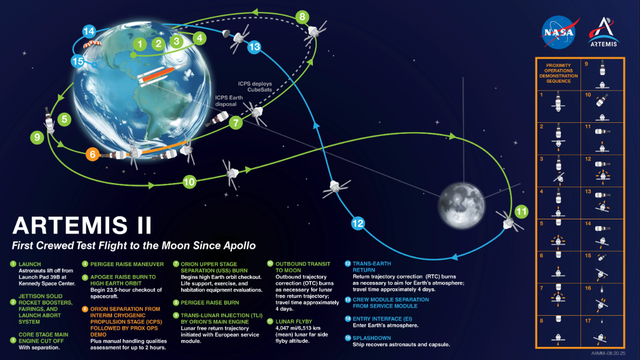
The four astronauts on board the NASA Artemis II mission are gearing up for a groundbreaking lunar flyby that will take them farther from Earth than any previous crew. Astronauts Reid Wiseman, Victor Glover, Christina Koch, and Canadian Space Agency astronaut Jeremy Hansen are busy inside the Orion spacecraft, finalizing their preparations for the mission's highly anticipated flyby of the moon. They are conducting a demonstration of the Orion's crew survival system spacesuit and reviewing the final science objectives before performing the last outbound trajectory correction burn before the lunar encounter.
Mission controllers have planned a carefully orchestrated sequence of events as Orion enters the moon's sphere of gravitational influence at 12:41 a.m. EDT on Monday. The spacecraft's trajectory was specifically designed to intercept the Moon before transitioning from Earth's gravitational influence to the moon's, eventually falling back towards Earth. This delicate balance between the gravitational forces of Earth and the Moon guides the spacecraft's path in a complex gravitational dance.
During the flyby, the crew will photograph and observe 30 features across the lunar surface, including significant targets like the massive Orientale basin and the Hertzsprung basin. The astronauts will study these craters from multiple angles as Orion approaches, providing valuable insights into lunar geological features and evolution over billions of years. The Artemis II crew is expected to surpass the distance record set by the Apollo 13 astronauts, reaching a maximum distance of roughly 252,760 miles from Earth.
Throughout Monday's encounter, several milestones are planned, including a communications blackout when the Moon blocks radio signals between Orion and Earth's Deep Space Network. Once Orion reemerges from behind the moon, engineers anticipate quickly reacquiring the signal and resuming communications with the astronauts. The Artemis II mission is a significant milestone in NASA's Artemis program, paving the way for future crewed missions to the lunar surface later this decade.
In conclusion, the Artemis II mission represents a historic moment in space exploration as the crew embarks on a groundbreaking lunar flyby, pushing the boundaries of human spaceflight and advancing our understanding of the Moon's geological features. The astronauts' observations and data collected during the mission will contribute to ongoing research and pave the way for future crewed missions to the lunar surface. NASA's Artemis program continues to make strides towards returning humans to the Moon and beyond, marking a new chapter in space exploration.