Unveiling the Mysteries of the Milky Way's Central Region: Insights from ALMA's Groundbreaking Discovery
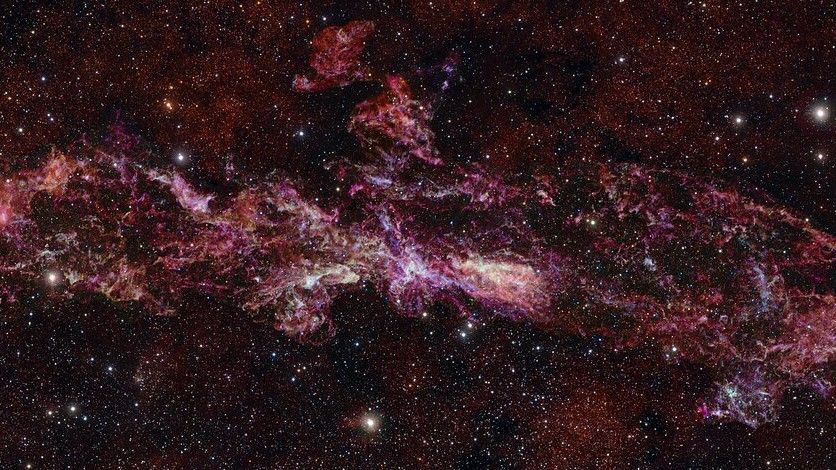
A groundbreaking discovery has been made by scientists using the ALMA telescope, who have produced an incredibly detailed map of the Milky Way's central region. This map, covering 650 light-years around the galaxy's central black hole, offers a glimpse into the chaotic gas clouds that existed shortly after the Big Bang. The Central Molecular Zone (CMZ) within the Milky Way's center is a dense region filled with molecular gas clouds, resembling the conditions of the early universe. The image captured by ALMA is the largest ever produced, showcasing a variety of structures and phenomena within the galactic center.
The observations made by ALMA have provided scientists with valuable insights into the extreme conditions that shaped the evolution of the Milky Way and other ancient galaxies. By studying the movement, velocity, and chemical composition of gas within the CMZ, researchers hope to unravel the mysteries of star formation and evolution in the early universe. The CMZ is a dynamic region surrounding the supermassive black hole Sagittarius A*, characterized by colliding gas clouds, supersonic flows, and hyperactive stars that influence the galaxy's evolution.
The ALMA CMZ Exploration Survey (ACES) has brought together a global team of scientists to study the enigmatic CMZ in detail. Through their research, the team has identified over 70 types of molecules present in the galactic center, shedding light on the complex processes at play. The survey's findings, published in the Monthly Notices of the Royal Astronomical Society, offer a glimpse into the intricate interplay between gas dynamics, star formation, and chemical composition within the CMZ.
One of the intriguing discoveries made by the ACES team is the Millimeter Ultra-Broad Line Object (MUBLO), a mysterious structure visible only at millimeter wavelengths. This compact object, filled with fast-moving gas, poses a unique challenge to astronomers as its characteristics do not align with any known astronomical objects. Exploring anomalies like MUBLO could provide valuable insights into the extreme environments of the ancient universe and the processes that shaped galaxies in their early stages.
The detailed map of the CMZ created by ALMA opens up new avenues for understanding the evolution of galaxies and the formation of stars in extreme environments. By studying the chaotic conditions within the galactic center, scientists hope to gain a deeper understanding of how stars are born and how galaxies evolved in the early universe. The groundbreaking observations made by ALMA represent just the beginning of a journey towards unraveling the mysteries of the ancient universe and its impact on the formation of galaxies.